














Set in the 1950s, the play “12 Angry Men” offers a behind-the-scenes perspective on the American legal system, exploring the power of individual pursuit and the impact of reasonable doubt on a case filled with hasty judgment.
The play was held on Jan. 16 and 17, and takes place at a New York County courthouse on a hot, stuffy day, where a jury is tasked with determining the fate of the accused perpetrator.
The defendant, an unnamed Puerto Ricoan 19-year-old boy, is the primary suspect in the stabbing and murder of his father and faces the death penalty if convicted.
In contrast to the other jurors, Juror 8, played by junior Madison Curchoe, is the only juror who argues that the boy is not guilty of the crime.
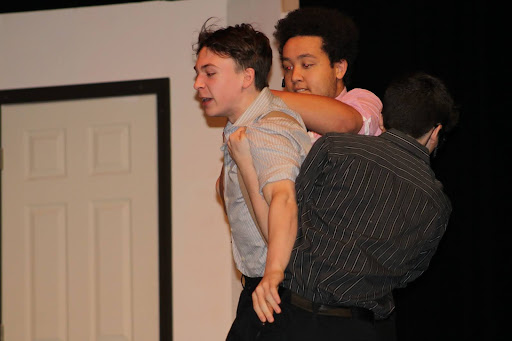
On the other hand, Juror 3, played by sophomore Will Kent, is determined that the boy is guilty, and aggressively shuts down Juror 8. Throughout the play, his anger intensifies as more jurors lean toward the verdict of not guilty.
Juror 8 utilizes pieces of overlooked evidence to support her argument that the boy is innocent. For example, she points out how the knife used in the murder could be purchased practically anywhere at a cheap cost. She even purchased an identical knife to demonstrate that the weapon was easily obtainable, outruling the argument that it was distinctive and couldn’t have belonged to anyone else.
As the play transitions towards its conclusion, Juror 8 continues to reanalyze evidence that initially appeared as proof of guilt, transforming them into compelling arguments for reasonable doubt.
Through Juror 8’s unwavering fight, the play explores how bias can lead to rushed judgment, and that empathy along with critical thinking are essential for justice.
The play ends with Juror 3 lashing out at the jurors, after they all solidified and changed their votes to not guilty, leaving him to feel alone and ostracized. Once the room clears, he begrudgingly accepts the verdict and admits that the boy is innocent, demonstrating the triumph of reasonable doubt over prejudice.